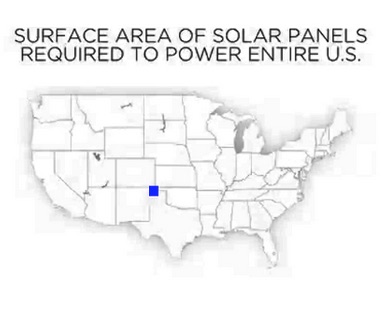
FP2W referees evaluate Elon Musk’s “Blue Square” statements.
Elon Musk has said that the blue square pictured above is all the surface area needed to supply 100% of American energy needs with Solar photovoltaics (PV). Watch the video below, scrolling to minute 3:10 for the actual quote.
Is this correct?
Some numbers to help you out:
Per Eia.gov - total US energy consumption was 98.4 quads in 2014.
http://www.eia.gov/totalenergy/
Using the handy energy calculator, we see 98.44 quads = 28,849TWh
http://www.convert-measurement-units.com/conversion-calcula…
That’s the total energy used each year, so how much is that in terms of power - i.e., the rate at which it is used, i.e., how many watts is it? We’ll have to divide the total by 365 to get the energy used each day, then divide that by 24 to get the watts. So…
28,849TWh/(365X24) = 3.29TW
So…we would need enough SolarPV panels to supply 3.29 terrawatts - wait, we need the 3.29 TW 24/7 and solar doesn’t work at night, and sometimes it’s cloudy, so we’ll have to multiply that 3.29TW by some number to account for the capacity factor - to make sure we have enough panels capturing the total energy needed in a 24 hour period. Is 2.5 sufficient? Too low, too high? Let’s go with it:
3.29TW x 2.5 night+cloud factor= 8.225 - let’s just say 8 TW.
How many Solar PV panels are required to supply 8TW, and how much surface area would they take up?
Does it match Elon Musk’s Blue Square.
So I’m getting some flack on other channels about this image. There is some question about the blue square. It seems from Elon’s talk that he is saying that that area, covered with solar PV, can capture 100% of the energy needs of Americans. We’re assuming that, because of the battery, no energy is lost. Whatever falls from the sky and is captured by the panels is made available to Americans. (Actually, some folks point out that storing it in a battery and then accessing it drops the efficiency a few percentage - but we’re doing back of the envelope rough estimates here). So the question is - with perfect recovery from Solar PV - PV at maximum capacity - how much surface area is needed to supply the energy needs of every American? Is it the size of the blue square? Or is it some other size? Who wants to take a stab at the math? Action!
KR: that’s a good question, and the calculations have been done many times before. Here are some of them,and you can probably find others by doing a Google search.
For the US: www.nrel.gov/docs/fy12osti/51946.pdf. NREL is a very respected organization.
http://mic.com/articles/91313/here-s-how-much-renewable-energy-it-would-take-to-power-the-entire-world
http://modernsurvivalblog.com/alternative-energy/amazing-total-area-of-solar-panels-to-power-the-united-states/
The NREL charts say that the total technical solar capacity in the US for Rooftop PV and Urban Utility scale PV is:
Type - km^2 - TW - TWh
Rooftop PV - 0.664 TW - 819TWh
Utility Scale PV, Urban - 25,369km^2 - 1.2 TW - 2,232TWh
It doesn’t say how much area the rooftops require. Using the same ratio as utility scale PV the area for rooftop PV is 9308km^2.
The total energy of these two sources of solar is 819TWh + 2,232 TWh = 3051 TWh.
Total US Energy Consumption is 28,849 TWh, so the Urban and rooftop PV can supply 3051/28,849= 10% of the power needed. Not 100%, as Elon says. (actually, he says 100% fossil fuel supplied electricity, now that I look at the video. Maybe that is 10% of total demand?)
And how much space does the 10% take up? Per NREL (25,369 + 9308)km^2 = 34,677 km^2
That is roughly the area of New Jersey, Rhode Island and Delaware combined. http://en.wikipedia.org/wiki/List_of_U.S._states_and_territories_by_area A bit bigger than Elon Musk’s #BlueSquare.
Then, to go to 100% of US energy demand would be 10 times that amount, or 346,770 km^2 which is bigger than New Mexico, smaller than Montana.
KR: Rezwan, thanks for that analysis. As they say, the devil is in the details. Let me know what you think of my comments below.
I think the NREL report makes some very conservative assumptions about the US solar buildout potential. I think the solar potential is far higher, if we take another look at some of those assumptions.
Rural solar potential - Even NREL states that the rural solar potential is huge - 280,600 Twh, which is about 10 times the US current Energy consumption of 28,849 TWh. And that’s excluding all areas with slopes greater than or equal to 3%, all federally protected lands, inventoried roadless areas, and all areas of critical environmental concern such as wetlands. Through energy efficiency upgrades such as switching to Passive House designs and switching to electric cars, the US could easily cut its total energy usage in half, so then the potential would double to 20 times the US total energy needs, just from rural solar. Further, NREL assumes a solar module efficiency of 13.5%, whereas today 20.5% efficiency solar modules are commercially available and are still increasing, and lab efficiencies of 44% have been achieved. If we assume an average module efficiency of 20.5%, the total available rural solar potential would be 30 times the total US need.
Concentrating solar power - NREL states that the rural solar potential is huge - 116,100 Twh, which is about 4 times the US current Energy consumption of 28,849 TWh. By including the above mentioned energy efficiency upgrades, that would double to 8 times US Energy consumption, just from concentrating solar solar power. Unfortunately most of this solar potential is in the Southwest, and it would be costly to get that energy to other parts of the US. Also, the cost of CSP is not likely to come down as much as solar PV.
Urban Utility scale photovoltaics - By including the above mentioned energy efficiency upgrades and using 20.5% efficient solar modules rather than 13.5%, the percentage of total US Energy needs meet by urban utility scale photovoltaics could be increased from 10% to 30%. Furthermore, NREL excludes huge areas which I think have significant potential: Parking lots, roads, all urbanized areas with imperviousness greater than 1%, slopes greater than 3%, and urban areas less than 18,000 square meters. They don’t breakout the numbers on those areas, but just covering parking lots and including urban areas of less than 18,000 sq.meters could hugely increase the solar potential, especially in densely populated areas like NJ.
Rooftop scale photovoltaics - They only assume that 22%-27% of roof areas for residential buildings are available, due to shading and other restrictions. They don’t include vertical walls at all. However, as the price of solar comes down, it is likely that it will be cost effective to install solar on vertical walls, north facing roofs, and partially shaded roofs, so the potentially available areas will be far higher. Also they don’t seem to include small scale free standing solar potential in backyards, etc.
Just take a look at Germany for what can be done with today’s technology without ruining the environment. They have about as much solar insolation (average amount of sunlight per unit area) as Alaska, but as of 2012 Bavaria alone produced more solar energy than the entire United States.
RR: Well, those restrictions may have some basis in engineering. In any case, looking back at Elon’s video, he says clearly that most of this square energy will come from rooftops, nothing else needs to be disturbed. It’s around minute 3:35I https://youtu.be/yKORsrlN-2k?t=3m30s I did see the numbers for rural and concentrating solar power, but to me, that’s energy clutter. I was thrilled with Elon’s announcement precisely because he said you wouldn’t need that space. Also, going back to the NREL report, the rooftop solar does seem to be less efficient than the other types. Looks like they are giving it a 14% efficiencey, v. 30+ for concentrating solar power. Must run now, will look at your numbers again tomorrow.
KR: thanks for pointing me to Elon Musk’s quote at 3:35. Although the overall impression that he gives may be misleading, after looking at the numbers more closely, I think he’s not far from the NREL estimates for solar rooftop potential. Let me know what you think about my calculations.
First, he’s only talking about electricity generation, not all energy generation. 2012 US electricity consumption was 3,695 Twh, about 13% of total energy consumption. That makes a huge difference—it hugely cuts down on the area needed for solar. Secondly, he talks about what it would take transition the US to carbon free electricity, not 100% solar. I interpret that as meaning that in his scenario existing hydro, wind and nuclear would stay the same or be supplanted by other low-carbon energy, and only the fossil fuel component would be supplanted by solar. The US currently gets about 67% of its electricity from fossil fuels, and 0.4% from solar, so in his scenario only 67.4% x 3,695 Twh = 2,490 Twh of electricity would neet to come from solar. (Source: www.eia.gov/tools/faqs/faq.cfm?id=427&t=3)
The NREL report says 800 Twh is the US solar rooftop potential. If you increase the solar panel efficiency from NRELs 13.5% to 20.5% that would increase the potential from 800 Twh to 1215 Twh. Further, Musk says “most” (not all) of the electricity can be generated by rooftops. “Most of that area is on rooftops” could be interpreted to mean as little as 50.1% of the area, which would bring the required amount down from 2,409 Twh to 1,247 Twh. So now we have Elon’s 1,247 compared to NRELs 1,215 Twh—we are already very close to Elon’s numbers. I think as solar technology advances we can increase the % of available rooftop surfaces that are suitable for solar PV from NREL’s 22-27% to a much higher number. You only have to increase that percentage a little bit to come to Elon Musk’s numbers.
Third, electricity from wind energy and other renewables are only to going to increase in the future, so that lessens the need for solar panels, but that’s not required to make Elon’s numbers work.
Fourth, energy efficiency can greatly reduce the need for electricity, but that’s also not needed to make Elon’s numbers work.
The bottom line is that I don’t see any factual errors in Elon’s claims, although they could easily be misinterpreted and could even be misleading to many people.
KR: we need to have a math party! I’m not so sure about your calculations. We need to sit down with our sources, some snacks and a whiteboard.
For example, electricity 13% of energy consumption? I thought it was 40% http://en.wikipedia.org/wiki/Energy_in_the_United_States
Plus it’s not enough for Elon’s numbers to work in some conditional, technical sense. They have to work in a way that matches the vision he is laying out. People listening are hearing the vision and missing the disclaimer. He has a responsibility to make things really clear.
This is a problem because the Carbon bathtub is filling up - http://ngm.nationalgeographic.com/big-idea/05/carbon-bath - and we have a lot of work to do to reverse this. Elon’s video suggest that he has just solved the climate problem, with that blue square, and now we can all relax and become complacent. It seems that what he has really done is made it more likely for Solar energy to deliver on its promise, by providing some back up power to level out the grid fluctuations.
Technical disclaimers aside, most of the presentation is designed to get you to think the blue square solves everything. Some quotes:
“That blue square there is the land area that’s needed to transition the united states to a zero carbon electricity situation…and most of that area is going to be on rooftops”.
Followed by: “That image is an important one to bear in mind when people are thinking about solar power. Like how much will it take? Is it going to take some enormous amount? No, it’s just that blue square. Blue square.” https://youtu.be/yKORsrlN-2k?t=3m46s
Yes. It’s important to bear in mind what people are really thinking about when they ask “how much will it take” regarding solar power. They aren’t asking “how much, technically, to meet 50.1 percent of just our electric needs, assuming we consume 50% less electricity, so that’s half of half, so…er…how much space will it take to meet 25% of just our electricity needs?”
Plus, this is Elon Musk we’re talking about! Designer of the electric car. The hypothetical person asking Elon about how much solar energy we need would probably be assuming that this energy should also cover the electric car. Right now, ~30% of energy is for transport. So add that to the electricity 40% + 30%=70%.
The person asking “how much will it take” wants to know how much for the 70%. And it’s not just that Blue Square. It’s 7x that blue square.
We all have a responsibility to make it clear what the stakes are and how much each thing is contributing to the zero carbon goal. If this is 13% of the zero carbon goal, he should say, it’s 13%.
This is the goal of the Footprint to Wings Zero Carbon Scoreboard, by the way. To get really clear on the probable impact of each proposal.
Footprint to Wings is ad-free and has taken thousands of hours to research and write, and thousands of dollars to sustain. If you find any joy and value in it, if you want this platform to be the best it can to help you take your state to net zero carbon, please consider becoming a Member and supporting with a recurring monthly donation of your choosing →
™ & © Footprint to Wings Inc and its Licensors, except where noted. Powered by InterServer.